
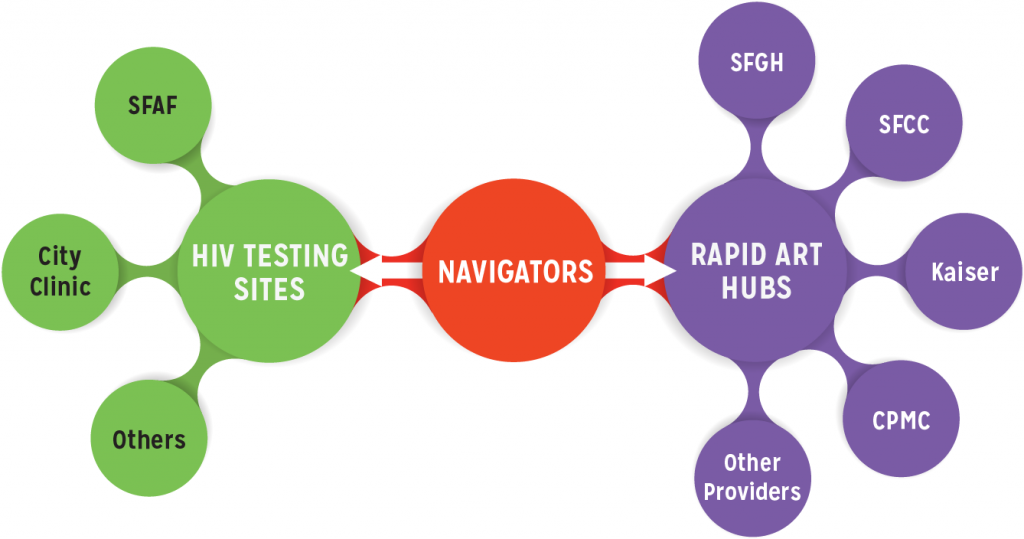
The overall goal of the RAPID (Rapid ART Program Initiative for HIV Diagnoses) program is to create a set of “hubs” around the city where persons newly diagnosed with HIV (or out of care) can rapidly access antiretroviral therapy (ART) and have a smooth transition to their medical home. In order to accomplish this goal, a RAPID steering committee established hub locations, standard operating procedure (SOP) for ART start, and SOP for transition to a primary medical home. The committee works with SF Department of Public Health surveillance (now “ARCHES”) to track the uptake and outcomes of persons participating in the program. We build on the existing LINCS programs at SFDPH to create and support hubs for rapid initiation of ART to individuals.
We start ART:
Within 48 hours –
- If acute/early infection (recent negative Ab test, RNA+/Ab– or recent symptoms of acute retroviral syndrome) or
- Evidence of advanced infection (opportunistic infection or a CD4 count of less than 200)
Within 5 days –
- All other newly HIV-diagnosed persons
The program aims to provide ART for up to 5 days for these individuals until they are transitioned into their medical home.
RAPID Resources
Publications
- *New* Outcomes of Rapid Restart Among People With Previously Diagnosed HIV at a Safety-Net HIV Clinic in San Francisco. JAIDS Journal of Acquired Immune Deficiency Syndromes 100(3):p 256-264, November 1, 2025.
- Development of a Citywide Rapid Antiretroviral Therapy Initiative in San Francisco. AJPM. 2021 November, Pages S47-S54.
- Decreased Time from HIV Diagnosis to Care, ART Initiation, and Virologic Suppression during the Citywide RAPID Initiative in San Francisco. CID. 2020 May 25.
- RAPID ART: High virologic suppression rates with immediate ART initiation in a vulnerable urban clinic population. AIDS. 2018 December 21.
News & Updates
9.22.15 Consortium Meeting Agenda & Slides
The quarterly Getting to Zero SF Consortium Meeting was held 9.22.15 at 25 Van Ness. Agenda: 5:30-6 PM CAB pre-meeting 6:00 Welcome, Background, Year 2 – Diane Havlier 6:20 CAB report back – Jeff Sheehy, Matt Sharp 6:25 New data report back – Susan Scheer 6:40 Legislative and advocacy update – Dana Van Gorder, Andy…

White House Office of National AIDS Policy Director Douglas Brooks visits with G2Z
During a recent visit to San Francisco, White House Office of National AIDS Policy Director Douglas Brooks visited with Getting to Zero San Francisco’s steering committee at the San Francisco AIDS Foundation. Dr. Susan Buchbinder presented an overview of the Getting to Zero structure, committees, and metrics followed by a discussion of opportunities for sharing…

Large Study of PrEP Use in Clinical Practice Shows No New HIV Infections
In one of the first and largest published evaluations of the use of preexposure prophylaxis (known as PrEP) to prevent HIV infection in a clinical practice setting, researchers at Kaiser Permanente found no new HIV infections among patients during more than 2.5 years of observation. The study was published today in the journal Clinical Infectious…